



Workshop on: Multiple, Complex & Cascading Extreme Conditions
Workshop materials
Table of Contents
Framework – Prof. Amnon Reichman:
Important to start with broad definitions. Emergencies (threat to vital interests, uncertainty, urgency) leads to a consolidation of powers – fewer ex ante and in opere checks, endangering rights, partly due to an environment of fear (us vs them mentality).
Design of protocol: who (Actor? Federal? Local?) gets to do what? How does mitigation, rehabilitation play into their mission scope? How do we build resilience? How does authorization work (legislation, executive order)? Should an emergency be declared, and if so, with sunset clause? What is the role of courts, and how do we decide upon a proportional process?
A disaster is a materialized emergency
This is a single silo event. But what about complex and cascading situations? Need terminology
What differentiates a single silo event from other crises? Are generating factors important or just the social impact? Temporality – do crises emerge sequentially or in parallel? The question here is, how do we identify that we are no longer in a single silo event?
Need to consider overlapping jurisdictions of agencies as well as the transnational dimensions of such emergencies. Also need to ponder the impact in terms of rule of law and democratic backsliding
An emergency that makes an emergency complex is that it affects multiple social systems – law, economy, media, bureaucracy, religion, etc. Network effect of emergencies
What makes a social system vulnerable? How much stress can it handle? Social psychology is another aspect, as different cultures – legal as well as social – deal with emergencies in various ways; context matters.
Culture matters not in terms of outcome necessarily, but in terms of preparedness, resilience, expectations, institutions, compliance, etc
Need to:
1. Get the analytical terminology right
2. Approach through interdisciplinary studies for a multidimensional perspective
3. Understand the narrative – how are things connected?
4. What are we missing?
Focus of this group is extreme conditions, complex, multiple, cascading emergencies
Does democratic backsliding temper responses to cascading, multiple, or future crises? Democratic countries are different from non-democracies, group should focus on the former as it is of greater concern to us and is also easier. Unfortunately, that excludes half of the world, but one could argue that an authoritarian regime is in a state of democratic crisis.
Should aim to publish an edited volume of papers on cascading emergencies in the next two years. The idea is not to come up with a grand theory of cascading emergencies but to contribute different perspectives.
Taxonomy discussion – Prof. Amnon Reichman
See also: Taxonomy workshop synthesis by Amnon Reichman and Deborah Shmueli
What do we mean by “single silo” event? An originator event that we traditionally associate with a classic disaster – an earthquake flood, a pandemic, fire. It is the man-made response to it that causes the impact that we care about. Among anthropic crises, we have wars, terrorism, coups, and other such kinetic events, socioeconomic meltdowns, political crises.
There is societal vulnerability, or more than one, in a single silo event. An event – earthquake, war – that puts stress on the vulnerability. Uncertainty, urgency, and serious threat turn that stress into an emergency. If any of these conditions are not met – if society can cope – an emergency is averted. Vulnerability can be enduring – can be reduced by mitigation, adaptation, transformation. Such action lowers the risk of an emergency. Post ante, we deal with recovery and rehabilitation – if these are done well, the event will not be recurring. If the event repeats due to unattended vulnerabilities, it is still a single silo event that is recurrent.
Cascading event is a single silo event that is connected to another one or more. It can be causality or correlation that connects the events. Each event occurs because of a vulnerability – law, politics, economy, bureaucracy, health, education, religion. Without further vulnerabilities, there would not be a cascade. These events are not necessarily linear.
Multiple events is an issue with temporality – two unrelated events occur in the same timeframe, putting stress on each vulnerability in society, but also collectively on society as a whole due to the congruency of the events. Example – series of elections created a political crisis, and then there was Covid.
Complex events can be single silo, cascading, or multiple. It is a matter of degree, not dimension. A complex condition is when the state, or rule of law, itself is under threat of collapse. Example – the Weimar Republic. Complex crises also cross jurisdictional boundaries, bringing into account the other systems over which you have even less control. A third factor in complex crises is the knowledge component – you don’t understand what is going on.
How long do we allow between events to call it a cascade, or how small of an interval to call it a multiple crisis? Is the matter of a situation being a single silo or cascading event a question of narrative? For example, was Hamas planning on attacking Israel regardless of the political turmoil?
Theoretical discussion: Emergency Theory Meets Cascading Situations – Dr. Nadiv Mordechay, Dr. Fady Khoury, Dr. Nadav Dagan and Dr. Uri Ansenberg
Definition of cascade: a serious disruption of the functioning of a community or a society involving widespread human, material, economic, or environmental losses and impact, which exceeds the ability of the affected community or society to cope using its own resources (United Nations International Strategy for Disaster Reduction, 2009)
Working definition: a need for cross-border emergency response; interaction of natural and human systems; evolution of crisis may be random; critical infrastructure is paramount; relationship between vulnerability, politics, policies, and crisis management capacities.
In the diagram below, these are cause-effect chains. However, given the interconnectedness of human systems nowadays, some of these effects might become independent causes of their own that cannot be directly attributed to the primary cause. Some examples of (b) are the Baltimore train accident (2011) which caused internet outages in large parts of the United States; another example is the flooding of the Charles river in Prague (2002) which affect four neighbouring countries and required NATO intervention. A third example is the Eyjafjallajökull volcano (2010) in Iceland that shut down air traffic in Europe for a week, and a fourth example could be the Tokyo earthquake (2011) that caused a tsunami and then a nuclear situation. One issue with these events is that some of them are hidden vulnerabilities and unforeseeability.
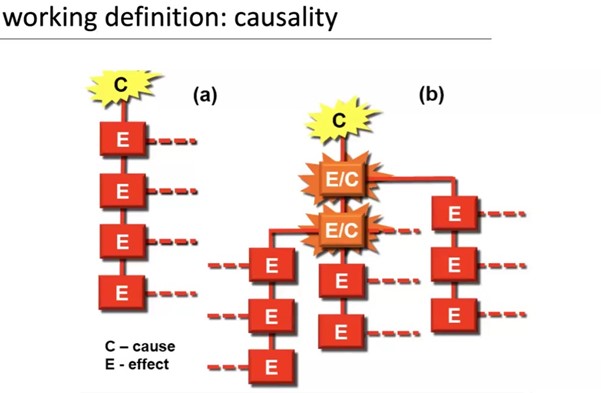
Is (a) single silo, and is (b) cascading?
Difference between conventional and cascading emergencies: 1. Impact and scope; 2. Planning and preparedness; 3. mitigation strategies; 4. risk models and uncertainty; 5. tipping points; 6. infrastructure and risk mapping; 7. coordination across agencies; 8. public involvement; 9. duration and escalation over time; 10. anticipation of direct and indirect impacts.
Cascading emergencies are transformative – classical constitutional emergency law is intended to facilitate exit without changing the model of democracy; cascading emergencies will at least change the public conversation of the community.
What is a state of emergency? Definitional difficulty, but, broadly, variables and criteria are profound and pervasive destruction, distinctness, temporality, imminence and probability, incompetence, predictability.
Concentration of legal authority and separation of institutions: he who declares an emergency shall not exercise power (hetero-investiture), sunset clauses, prohibition on changing the constitution, non-transformative. This was the Roman model. Modern emergency models shift power towards the Executive; question is, who has the power to declare one, and what legal oversight or judicial review can be provided in these times. Research shows that emergency powers tend to be normalized over time. Especially in economic situations, Executive power has increased drastically in terms of economic policy.
In matters of national security and terrorism, counterterrorism laws tend to become permanent. This is partly because terrorism has been ongoing for decades.
One way to prevent excess is that courts should be less deferential to the Executive. Another is to invest declaratory powers with the Legislature, though most democracies have an Executive that has majority in the Legislature.
Questions on cascading emergencies:
- Does each element in a cascade require a declaration or is one overarching declaration sufficient?
- Relationship between politics and expertise – where should decision-making powers lie?
- Jurisdictional fragmentation presents a challenge for addressing a cascade – should institutions overreach in the name of cooperation?
- How do we prevent the entrenchment of expanded Executive emergency powers during a prolonged cascade into a ‘new normal’?
Is climate change an emergency? Is democratic backsliding? If so, who has the authority to declare it so, and how should measures be implemented?
Much work remains to be done in reading disaster studies in parallel with emergency law.
Case Studies
- The Yugoslav Wars – Dr. Shiran Altman-Battler
- Sudan – Dr. Magdalena (Magda) Pacholska
- Lebanon, West Africa, and Iraq – Dr. Daniel Chardell
- Brazil – Dr. Stephanie Assaf and Dr. Shani Schnitzer
- Covid-19 – Dr. Benjamin Newman and Dr. Nofar Yakovi Gan-or
The Yugoslav Wars
Dr. Shiran Altman-Battler
Six new states comprise the erstwhile Yugoslavia; shared common language – Serbo-Croation – and physical features – Slavic. However, ethnic identities, religious differences, and history divided them – particularly the genocidal Croat group, the Ustaše, which murdered one million Serbs during World War II, and the reciprocal Serb killings of Croats and Muslims in territories controlled by them. Josip Broz kept the six groups united with an iron fist and reduced ethnic tensions, but after his death in 1980, the economic crisis and the fall of Communism in Europe saw a sharp rise in Serbian nationalism. Slobodan Milošević, president since 1989, tried to keep Yugoslavia united under Serbian dominance but Croatia and Slovenia broke away from the union in 1991. This left half a million Serbs in Croatian and Slovenian lands, and with the excuse of protecting estranged Serbs, Milošević deployed force. War broke out in November 1990, and Bosnia-Herzegovina also declared independence in 1992; the ensuing violence saw the establishment of concentration camps and the murder of over 250,000 people and two million displaced people.
The US had traditionally supported a united Yugoslavia as a foothold against the Soviet Union during the Cold War and overlooked blatant human rights abuses. The UN adopted Resolution 808 only in February 1993, and established the International Criminal Tribunal for the Former Yugoslavia (ICTY). Conflict finally ended in 1995 with the signing of the Dayton Peace Accords.
The Yugoslav Communist Party’s attempt to reform and hold elections by the one person – one vote principle had initially sparked protests due to ethnic demographics of the country. In March 1991, the military had to be called in to quell the public disorder.
In March 2025, Belgrade again witnessed largescale popular unrest against President Alexander Voicic’s corrupt administration; sparked by roof collapse at newly renovated railway station in Novisad. Again, the regime enjoys support from Moscow, Beijing, Washington, and European capitals. Voicic has slid back to competitive authoritarianism since his rise to power in 2012; electoral autocracy.
In Serbia’s case, economic crisis and ethnic tensions created regime instability. The current administration has several members from the Milošević era, who have learned from their mistakes on how to handle civil unrest. Their measures to control the people are sophisticated, covert, and subtle.
These protests have served as an example to other Balkan states – N Macedonia in 2022, for example – to take their grievances to the street. Furthermore, sociopolitical instability in Serbia has allowed Russian and Chinese influence to grow in the country, and through it, to be disseminated across the region and Europe.
Discussion: Vulnerabilities need to be more clearly defined, stress points identified; unclear research question. Changing terminal points could bring in the Kosovo dimension, which might shed more light on the instability in Serbia. Interesting observation that ICTY, an international legal mechanism, created to solve one problem, has created another.
Need to consider the timelines in our case studies – how far do we go back? Can we connect the current crisis in Israel to the Holocaust? Would it have any analytical value? The Yugoslav case stretched from World War II until the present, focusing particularly on the last three decades – is that chronology appropriate?
Causality of complex crises can be difficult – the Yugoslavian civil war could be about economics, constitutional challenges, or ethnicity – and the narrative might limit our understanding of a crisis.
Sudan
Dr. Magdalena (Magda) Pacholska
The UN reports that over 30 million Sudanese are in need of basic necessities; there are water-borne diseases, internal tribal divisions and strife, displaced population, external funding issues. In this long-drawn crisis, where do we start the timeline? Each of these issues could be crises in and of themselves, stretching back decades.
Discussion: Is a crisis necessarily a departure from the ordinary? In the case of Sudan, that could be disputed. However, as a failed state, it challenges several assumptions we make about state power. The country has had six coups d’etat and been in a crisis ever since independence. It seems that the imperial era might have been a period of stability – what is the difference between classical constitutional theory of emergency, and a polycentric theory of emergency? Question also arises if the idea of statehood imposed on a tribal society is part of the underlying problem. Is the state always a solution to a crisis?
Lebanon, West Africa, and Iraq
Dr. Daniel Chardell
Lebanon: Prior to the port explosion in Beirut in August 2020, Lebanon was already in the midst of an economic crisis. It was also hosting refugees from Syria, and then Covid struck. The ammonium nitrate explosion, the largest non-nuclear detonation in history, exacerbated the effect of Covid as it worsened food shortages. An inquiry was delayed due to political reasons. This plurality of incidents returns us to the question of timelines – it is the culmination of the dysfunction in Lebanon since the end of the Civil War that ended in 1989. So, is the explosion a standalone crisis or is it part of a cascade or a complex situation?
West Africa: Ebola ravaged parts of Guinea, Sierra Leone, and Liberia in 2014/5. The latter two had just emerged from a civil war, and all three states are politically fragmented, poor, and have low trust in their governments. The porous borders between them facilitated the spread of Ebola. The cultural factor comes into play in this crisis because part of the reason for the difficulty in the eradication of Ebola was the religious burial practices of the populations. The timeline is also something to consider – the civil wars these countries went through had ended around 2000, but the lingering effects in terms of a weak state persisted. The government was also insensitive and ineffective in their communication with people likely to be affected by the disease. Many people hid the fact that they had been, or they knew someone who had been, infected. Conspiracy theories also emerged that this disease was ‘made up’ as a measure for the government to control the populations and stifle political dissent. The curfews imposed did little to alleviate these fears. Despite all these difficulties, elections were delayed but did occur – does this suggest that something also went right?
Iraq: In the early 1990s, Iraq was reeling from stringent UN sanctions after its failed invasion of Kuwait. Since it relied primarily on its oil exports, Iraq was hit quite hard by the comprehensive UN sanctions (75 percent of food was imported). Additionally, the First Gulf War had devastated the country’s infrastructure – roads, sewage treatment, water purification facilities, electricity, bridges, were in ruins, and food and medical distribution networks were frayed as a result. Uprisings broke out in the Shi’a South and the Kurdish North to add to the chaos. Iraq was becoming a failed state, but the main argument here is that it was becoming so by design as the United States and Europe were pursuing regime change at any cost. UN weapons inspections and control of food imports undermined Iraqi sovereignty. For our purposes, however, are these crises cascading or complex?
Discussion: We can have a crisis that recurs, that is not a separate crisis; they will continue to recur as long as the vulnerabilities that cause the crisis are not addressed. This is different from a cascade or a multicausal crisis, also from a complex crisis. The vulnerability is underlying and the variables there are poor mitigation, containment, and preparedness. Is cascade, then, also caused by an inability in a particular system to cope?
To be clear – cascade is a crisis that leads to another, complex is an indication of severity; it is possible to have a complex single silo event. One event leading to another does not necessarily mean strong causality. A cascading crisis is not the same as a multiple (multicausal) crisis, and any situation can be complex.
Brazil
Dr. Stephanie Assaf and Dr. Shani Schnitzer
In September 1987, there was a leak of caesium (Cs-137) in Goiânia, capital of the Brazilian state of Goiás. Although it may look to OECD eyes that there is extreme poverty in parts of Brazil, from the local perspective, there are gradations of poverty (favela, complexo, periferia), and Goiânia was not as bad as it could be.
Should we always apply a general and ‘objective’ definition or can it be contextual? There is no word in Portuguese for cascading effect – the closest is reação em cadeia or efeito.
In the case of this crisis, there were three things to consider: the radiological disaster of the Cs-137 leak, the political crisis, and the economic meltdown. The political crisis was the transition from a military dictatorship to a democratic society, starting in 1985. Economically, external debt, inflation, and unemployment were high as well. None of these are extreme in and of themselves, but they are all also intertwined with racial tensions.
The radiological crisis began when ragpickers found a discarded radiotherapy machine and took it apart. The Cs-137 was then distributed to several onlookers, which caused them to get sick. Hundreds of people were eventually affected and four people died due to radiation poisoning. Houses were demolished and affected areas were scorched to get rid of contaminants. Protests erupted during the funeral of one of the first victims, a little girl who was pardo – of mixed race. Had she been black, this case might have been ignored.
A foundation was set up, named after the girl, to offer medical services to poor people. The crisis occurred during the framing of the constitution, and the incident caused Art. 200 to be inserted into the document, guaranteeing health services to all.
Discussion: In this case, an emergency resulted in a positive development. Yet the government could have easily declared an emergency and returned to an authoritarian form of government. What made Brazil move in the other direction?
We must also consider if the economic meltdown was a crisis or an ongoing vulnerability, and if the latter, what is the relationship between a vulnerability and the trigger (to a crisis)?
Covid-19
Dr. Benjamin Newman and Dr. Nofar Yakovi Gan-or
This crisis was exacerbated by a loss of trust in scientific and political institutions; there was deep polarization. Abuse of emergency powers was rampant: Hungary prolonged emergency powers; the Knesset did not meet in Israel; citizens were tracked in Russia, China, and Israel; Czechia prevented judicial oversight of its emergency measures; Brazil appointed technocrats who cherrypicked the data to suit the government’s narrative; new laws were passed without sunset clauses in Nigeria, Poland, Hungary, and Russia that gave the government additional powers; in China, Bolivia, Cambodia, and Turkey, political opponents were silenced under emergency decrees; reports suggest that in India, health restrictions were enforced in a discriminatory manner unfavourable to Muslim communities.
Courts played a pivotal role in many countries in curbing governmental overreach. A clear difference can be seen between authoritarian countries and democracies in how well the judiciary functioned in this regard. Nonetheless, although the medical literature on long Covid is still unsure, the pandemic did have lingering, cascading sociolegal effects that impair democracy to this day. Democratic backsliding – which may have existed prior – can be seen in Poland, Hungary, Turkey, and Israel since the global crisis. Part of the social long Covid is also the polarization of society and the erosion of trust in scientific and political institutions. This decline in trust undermines the government’s ability to enforce policies effectively and maintain public cohesion during future crises.
Countries like New Zealand, that maintained daily press briefings and explained the criteria for exit strategies elicited a high degree of public compliance. In general, countries with stronger democratic frameworks were more resilient to backsliding; existing political turmoil was a detriment to good governance during the pandemic. Social vulnerabilities and inequalities intensify the impact of cascading disasters like Covid and lead to differing recovery opportunities. Even though democracies proved more resilient to the pandemic in the short-term, long-term damage has been done by populism and polarization.
Discussion: Covid seems to be a silo disaster, but the impacts are what are cascading. Some of these impacts could turn into crises themselves. Two spectra of resilience – one is uncertainty, vulnerability, and risk, and the other is mitigation, adaptation, and transformation.
Danger of the unbound Executive – does Legislature truly behave as a check on the Executive in times of crisis? Human nature suggests we turn to the government in fear and uncertainty, which makes the checks and balances all the more important.
Cascading emergencies: A framework and preliminary empirical evidence – Prof. Stefan Voigt and Prof. Christian Bjørnskov
What exactly IS an emergency? Is climate change an emergency even though it takes decades to cause noticeable impact? The Oxford English Dictionary says that an emergency is a serious, unexpected, and often dangerous situation requiring immediate action. Merriam-Webster calls it an unforeseen combination of circumstances or the resulting state that calls for immediate action. These are also not clear.
Proposed definition: a series of events, which can be considered as a single unified event, in which several extreme conditions occur in relatively rapid succession.
This definition is also circular – what is ‘relatively rapid,’ or ‘extreme’? So do we know emergencies only when we see it?
Statistically, when do governments declare emergencies (that are not natural disasters)? In ascending order, alleged coups, political events, after coups, demonstrations and protests, civil war, riots and other violence, unknown. Usually more likely after multiple coup attempts, or repeated protests, strikes, and riots within a short period of a year. This is based on a database of approximately 850 emergencies.
Cascading terrorism is a common event.
Events can be spread geographically, making it more difficult to identify cascades; events are usually separated by a limited period of time, too.
There is a difference between repeat events and cascades – the latter is a series of events caused by different factors. So, for example, if Hamas detonates a bomb in Tel Aviv and then does so again in two weeks, that is not a cascade but a repeat event.
In a database of approximately 570 coup cascades (coups following coups), it appears that coups follow substantial political instability and multiple factions are associated with them (different actors, not recurring); coup cascades have not been different from single coups, and they are substantially more likely to end in (re)democratization.
When do you have cascades? Are they random? Do institutions and policies matter? Do constitutional emergency provisions temper them?
Discussion: Repeating events sound like what, until now, have been called recurring events. The recurrence is due to an unaddressed vulnerability.
If a coup follows a coup, it is a recurring event by current terminology unless the actors are different. If the actors are the same, then they are exploiting the same vulnerability. Silos must address different vulnerabilities – coups are different from a general strike. If we treat natural disasters and wars as the same silo causing political instability, for example, we miss part of the explanatory equation. The social meaning of an earthquake and a terrorist attack is different. We need to look at cross-silo man-made events such as a coup and a war within the cascade framework.
Political instability does not necessarily make society unstable, and vice versa. For example, Sudan under Omar al-Bashir was politically very stable but society was highly vulnerable in so many aspects. There is not necessarily a positive correlation here between political and societal stability. Government is one of the players, we should not focus on it exclusively.
Since it is still not clear why some events lead to a cascade and others do not, it is useful to code them up for statistical analysis. We could then ask, for example, are cascades more common in recurring vulnerabilities?
Maybe instead of trying to create a theory that fits all emergencies, maybe we should look at it differently. If our departure point is democratic backsliding, we can then see how it fits within the framework of cascading emergencies. Instead of doing long histories and getting caught up in narrative differences, maybe we should look at a singular point in history – what are the components of this emergency, and how do they interact? The framework would be too broad, the questions different, if we club liberal democracies with autocracies.
Perhaps we should also consider how an event spirals into an emergency or cascades in societies that are already exhibiting vulnerabilities for a long time. Also, how do we measure? How do we evaluate something that half the country sees as a political failure and the other half sees as a correction? It is a question of narrative, then. How do we extricate our discussion from this? Yet if we are completely apolitical, ignore the polarization that might itself be considered a source of political instability, do we risk de-politicising deeply political conflicts, such as Northern Ireland, for example?
If we use democratic backsliding as a dependent variable, we can then ask in the case of an emergency or cascade, to what extent is this situation an indicator of a weak government?
We need to be careful how we think about political polarization – we tend to think of it in US terms, but that is only a fraction of what polarization is. If we use those standards, Denmark would look highly polarized over the past 40-45 years, but few who know the country would agree with that.
We also need to step outside the database of 850 emergencies used here as that does not include informal emergencies, without declaration. The lawfulness of a declaration of an emergency comes from three things: 1. has the declaration of a state of emergency been within the confines of the law? 2. has the implementation of the state of emergency been within the confines of the Constitution? and 3. has the end of the emergency (sunset clause) been in line with the Constitution?
Preliminary data suggests that the rate of unlawful emergencies due to Covid is higher in democracies, which might be an indication of the democratic backsliding that has plagued democracies in recent years.
Sources of Attraction to Leaders – Guest Lecture by Prof. Micha Popper
Law deals with contents and with rules while psychology deals with the informal, the hidden agenda. In a Freudian sense, law restrains instinct.
In Akiro Kurosawa’s famous movie, Kagemusha, an exhausted group of soldiers is shown marching slowly up a hill. On the top of the hill, is the figure of a man, sitting quietly. As each soldier reaches the figure, they seem to get a burst of energy, seem rejuvenated. But as the camera zooms in, you see that the leader, the man sitting atop the hill, is dead. The illusion of having a leader is powerful, people need leaders, need to feel protected. Democracy is not the default; the default is to seek a king or messiah. Of the ~195 states in the world, only 24 are full democracies.
A famous psychologist noticed that when people made decisions about economic investments, they all thought about profits but few, if any, thought about loss. In an experiment they ran, they put a choice before subjects in investing in one thing or another; when they added the option that the subject might lose his investment altogether, the results were different from the initial one. The issue here is not ‘truth’ but perception and information processing. For example, if you read Hollywood gossip tabloids, you may believe that the divorce rate is high in society, but if you read a paper that is, say, geared towards lawyers, you might believe the exact opposite.
People have certain biases, and the crisis is not necessarily the reality. One bias relevant to leadership is fundamental attribution error – the tendency to give much more weight to actors than to circumstances. We overvalue agency.
In another experiment, subjects were asked to choose a leader they felt close to and another they were distant from and describe them. Close leaders were described with personal, behavioural attributes while distant ones were described in the abstract, such as their ideology or rhetoric. Distant leaders are projected upon, the desires and hopes of their followers. Leadership is more about the followers than the leaders themselves. The real theory of leadership is the theory of followership.
Who is seen as a capable leader? He needs two characteristics – competence and compassion. Good campaigners are not necessarily good leaders. Creation of a group or team is essential for leadership – creates group identity and builds team spirit. A metaphor of leadership is fire – the leader is the spark, the ignition; the followers are the fuel, and the crisis is the oxygen. Ian Kershaw, famed biographer of Adolf Hitler, when asked what he could say about Hitler after researching him for 20 years, said that you could not understand Hitler without understanding Germany.
Leadership is not consistent – Winston Churchill, an immensely popular prime minister during World War II, could not beat Clement Attlee in the 1945 elections. What the British public saw as competence changed when they went from a state of war to a state of rebuilding. For that matter, charisma is also an illusion – look at Moshe Dayan before and after the Yom Kippur War.
Can leadership be learned? Yes, but it probably cannot be taught.
Leadership is neither good nor bad, it is a psychological phenomenon. Toxic leaders exploit circumstances to further themselves, good leaders build the nation. We cannot use rational means to understand an emotional phenomenon – you can be in love with someone who destroys you.
If you take a list of leaders commonly accepted as good, it will be hard to find commonality between them; however, it is easier to find commonality between their followers
Concluding discussion – Coordinator: Dr. Yahli Shereshevsky
If we are defining terms like cascading, multiple, and complex, it behooves us to pause and reflect upon why we need to define them at all. What is interesting normatively, and how does that relate to this project? What is unique, normatively or theoretically in the notion of cascade, multiple, or complexity? Maybe we will realize that we don’t need a unanimous working definition. We should approach the case studies we have discussed as interesting in and of themselves, and then see how our proposed framework increases our understanding of those situations.
We tend to study emergencies, be they economic, health, security, or something else, separately. However, it is interesting to see how one factor affects the others. Maybe, instead of trying to categorize them as cascading or multiple, perhaps we should ask how a combination of factors changes how we normatively think about the issue. We can ask these questions simultaneously.
A disease is identified by a cluster of symptoms – without agreeing on these indicators, it is difficult to talk about the disease, i.e., cascade, etc. However, we should refrain from focusing too much on theory and definitions.
The rule of law is a common thread in all our case studies, and the transformative potential of the legal framework is critical to address in our research.
People here seem to be interested in various aspects of emergencies. Some are interested in democratic backsliding, others in international law, and so on. Our end result can be a collection of papers that is not a definitive work, but rather, illustrate a spectrum of studies that covers the many interests of this group in relation to emergencies.
This group has two projects – one is definitional, and the other is the research projects of this group. The framing is very important; it creates a big picture within which individual research interests can be inserted.
Many of the case studies we have heard here seem to be single disaster events that had cascading impacts, except for COVID. We could look at the interaction between these cascading impacts.
People here are asking different questions – which means different data, different conclusions. Most of the case studies here have focused on a longer timeline than usual, and at cause-and-effect. These historical case studies can serve as an anchor to look at the theoretical issues. Yet we need to acknowledge the boundaries of case studies as well, particularly in man-made crises – if a set of case studies works under the hypothesis that governments exploit crises to strengthen themselves, and another set of case studies propose that governments target the democratic structure of their states and that causes crises, these are very different initial conditions and will lead to different conclusions about the crises themselves.
Limiting this project to finding definitions is not productive if it is an exclusive goal. We can certainly have a group that pursues this if they are interested in it, but we can also have an exploration of several case studies. A collected volume can reflect this diversity. The group as a whole can work with a common understanding of the terms.
The social meaning of what happens is very important – imagine if COVID had been portrayed as a terrorist attack by a Chinese company, or the recent fires in Israel were proven to be arson instead of a natural disaster.
Each project should be related between the rule of law and the compound emergencies. As a center that focuses so much on the rule of law, this should be central. Not each project necessarily deals in equal detail, of course, but this should be a central consideration. Also, the introductory essay in the collected volume should try to bind all our projects together as much as possible, and it is not really difficult to do so. This could perhaps get us past the definitional challenges.
We are departing from a whole field of research that already looks at extreme conditions, precisely why it is important that we see the bigger picture. Otherwise, how are we innovating or doing anything different? We don’t need the definitions nailed down – we can use tentative definitions and see how they inform our case studies, how they evolve from what the research shows us in those case studies. The common ground on definition can be extracted from what this workshop has discussed, but we should have clear guidelines to know what we are looking for when we study cascades or multiple crises.
Good progress has been made in this workshop on creating tentative categories. Even if we don’t agree completely on the definitions, this has been an important step in establishing a working definition.
A lot of what we discussed here has been in national silos, we should look at transnational dimensions as well – a purposeful decision was made to leave transnational issues for the next workshop.
When we look at international events, it might be that the vulnerabilities are different. For example, if the flooding in Czechia caused an emergency in that country, perhaps its neighbors were better equipped to deal with the situation and it is not a crisis there, in terms of evacuations, medical readiness, and so on. So an event that crosses borders may transform based on jurisdictional vulnerabilities, geographies, etc.
It is time to start thinking seriously about an edited volume or at least a special issue in a journal, everyone seems to be ready to publish.
We have not discussed sufficiently the question of timespan in our case studies. The issue with longer timespans is that it is more difficult to observe in contemporary events. We are also quite loose on causality. This is a term used with much caution in the humanities. We have also not discussed empirical aspects – our research is only as good as our data, and the quality of our empirical data needs to be robust.
Even with a liberal approach to the project, there must be some sort of common framework. What is common in all our projects is that they deal with more than one case of an extreme condition, be it multiple or cascading.
It would be helpful to have a memo circulated with our most accurate definitions of extreme conditions, cascading impacts, and cascading disasters – this will at least serve as a launching pad for further discussion. [See: Taxonomy workshop synthesis by Amnon Reichman and Deborah Shmueli]
It is important, at least henceforth, to be precise in our use of terms – if you want to say something about cascading impact, use the word cascading impact. When you want to say something about parallel or compound events, use the word parallel or compound; If you want to talk about vulnerabilities, don’t say it’s an emergency – because then it gets confusing. If we use words that mean something other than what we intend, we are trapped in a language game.
Summary by Dr. Jaideep Ashok Prabhu, Post-doc at BGU
prabhu@post.bgu.ac.il