
Autocratisation and States of Emergency:
A comparative Perspective
Dr. Nadav Dagan & Adv. Daphne Benvenisty
April 15, 2026 at 14:15-15:45
Via Zoom*
Event was recorded and is available on YouTube
Abstract
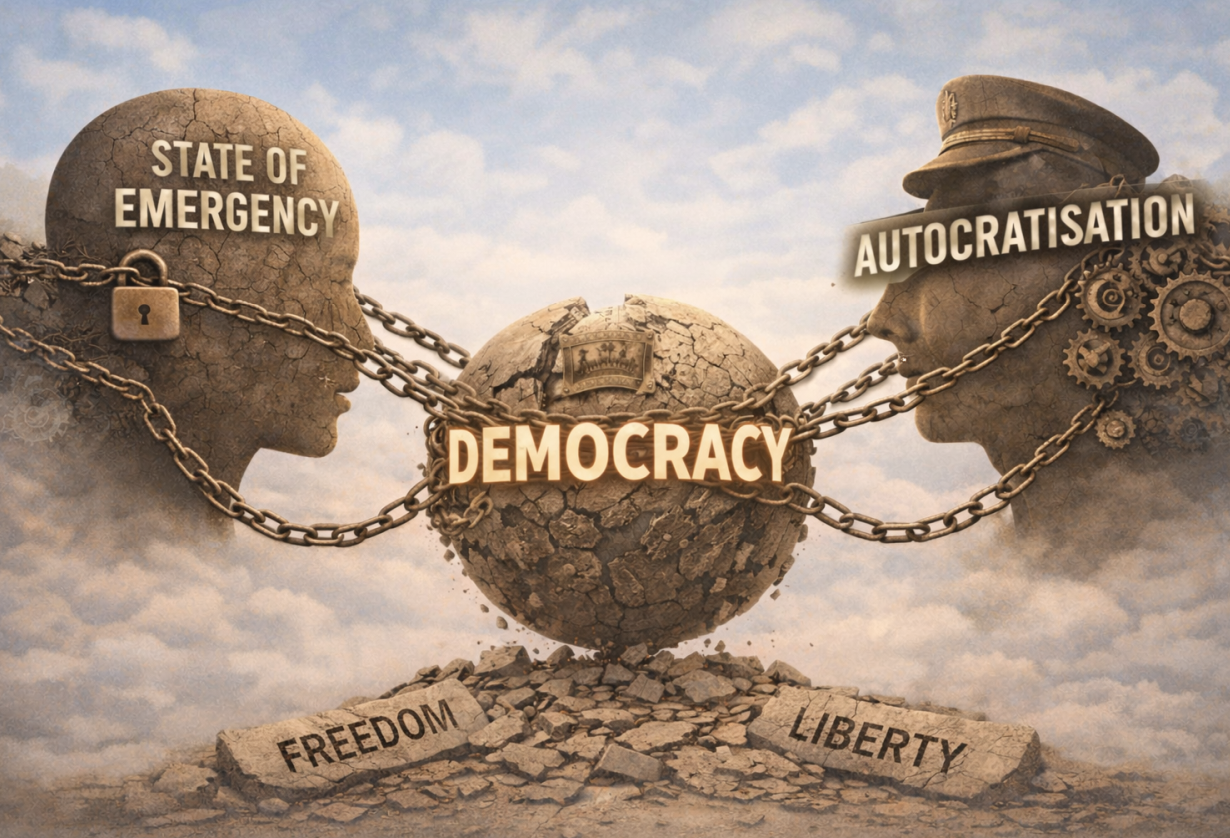
This report examines the intersection of autocratisation and states of emergency in contemporary democracies, suggesting that although each phenomenon has been studied separately, their interaction remains underexplored despite its potentially grave implications for democratic survival. Drawing on a comparative study of five formerly stable democracies that experienced substantial autocratisation: South Korea, India, Hungary, Venezuela, and Turkey, it shows that the convergence of autocratisation and emergency governance can accelerate and intensify democratic erosion, sometimes to the point of regime replacement and autocratic consolidation. The study identifies three main pathways through which this convergence harms democracy: the use of formal emergency powers, the use of extraordinary measures functionally equivalent to emergency powers, and the deployment of emergency rhetoric to justify urgent and exceptional action. Its central implication is that, while neither autocratisation nor emergency rule necessarily entails the other, their convergence may have a mutually reinforcing and deeply damaging effect on democracy as a whole.
The research report (in Hebrew) is available here
Nadav Dagan (PhD) is a Research Fellow at the Minerva Center for the Rule of Law under Extreme Conditions (University of Haifa), a Teaching Fellow at the University of Haifa, and a Senior Researcher at the Israel Democracy Institute. His research – both academic and applied – spans public law and democracy studies, with particular emphasis on governmental discretion, states of emergency, constitutional change, the foundations of contemporary democracies, and the dynamics of democracy and autocratisation.
Adv. Daphne Benvenisty is a researcher at the Israel Democracy Institute. Her research focuses on constitutional law, with an emphasis on anti-democratic legislation, states of emergency, and the legal frameworks of democratic backsliding from a comparative perspective. She holds an LL.B. and an LL.M. from the Hebrew University and clerked for Justice Neal Hendel at the Supreme Court.