
Who Governs Suwayda?
The Massacre of the Druze and the Politics of an Abandoned Territory
With Dr. Sawsan Kheir
Department of Multidisciplinary Studies Faculty of Humanities, University of Haifa
May 13, 2026 at 14:15-15:45
Hybrid event: Zoom and room 1013, Hamadrega building, University of Haifa
Abstract
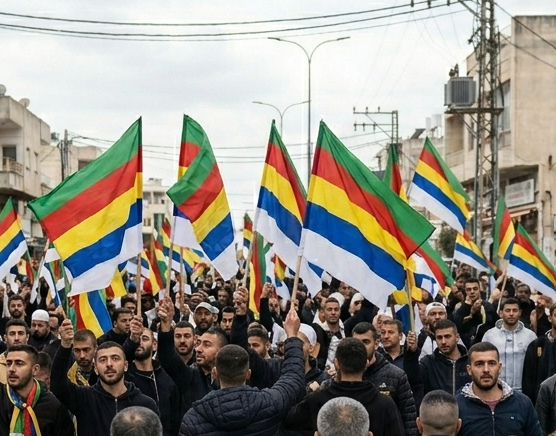
In July 2025, Suwayda became the site of one of the most brutal episodes of violence in post-Assad Syria. What began as localized clashes rapidly escalated into a campaign of mass killing, forced displacement, looting, abductions, sexual violence, and the destruction of homes, villages, and religious sites. Druze civilians were among the primary victims: women, children, elderly people, and families were killed in their homes and in public spaces; survivors reported sexual assaults, abductions, humiliation, and sectarian abuse; and entire communities were left displaced, traumatized, and unprotected. According to the March 2026 report of the UN Independent International Commission of Inquiry on Syria, more than 1,700 people were killed and nearly 200,000 were displaced during the July violence in Suwayda, with documented patterns of executions, torture, gender-based violence, and attacks that may amount to war crimes and, subject to further investigation, crimes against humanity.
Drawing on updated field data, survivor testimonies, documentation from the ground, and personal ongoing engagement with Suwayda since July 2025, Dr. Sawsan Kheir will examine the massacre not only as a humanitarian catastrophe, but also as a crisis of governance. Who governs Suwayda today? Is authority exercised by the Syrian state, by local Druze leaderships, by armed factions, or by no one in any meaningful sense? What does sovereignty mean when a state claims control over a territory but fails to protect its citizens—or when forces linked to the state itself are accused of participating in violence against a religious minority?And if governance is fragmented or absent, how do regional and international actors—Israel, Turkey, Russia, and the United States—shape the struggle over Suwayda’s future?
The lecture will situate Suwayda as an abandoned and contested territory: a place where the collapse of effective state protection, sectarian incitement, regional intervention, and geopolitical rivalry intersect. It will ask how a Druze-majority region became a battlefield of competing interests, and how the Druze of Suwayda came to pay the human price for struggles over power, security, legitimacy, and control. Through the lens of massacre, minority survival, and governance under extreme conditions, Suwayda will be examined as a case study in what happens when the state is simultaneously present, absent, and violent.
Dr. Sawsan Kheir is a lecturer and researcher who holds two doctoral degrees—one in Psychology from the University of Haifa and another in the Study of Religions from Åbo Akademi University in Finland. With over a decade of clinical experience as a psychologist, she transitioned fully into academia in 2017. Her research at the University of Haifa focuses on multiculturalism, contemporary religiosities, and values among Druze and Muslim minorities in Israel, exploring intersections of minority identity, gender, and social integration.
A member of the Druze community herself, since July 2025 Dr. Kheir has been actively engaged in volunteer initiatives supporting the Druze population in Suwayda, Syria. Her work includes international advocacy to raise awareness about the massacre of Druze civilians, as well as initiatives for documentation, humanitarian aid, and the development of community-based psychological support frameworks for women and survivors of the massacre.