

Yahli Shereshevsky
Faculty of Law and the Minerva Center for the Rule of Law under Extreme Conditions
University of Haifa
(with Michael Gross and Ryan Shandler)
June 24, 2026 at 14:15-15:45
Hybrid event: room 1013, Hamadrega building, University of Haifa** and Zoom*
* Link to zoom will be active here at the time of event
** See map here. For car entry permit to campus e-mail Michal at least one day before the event at: minervaextreme@univ.haifa.ac.il
Abstract
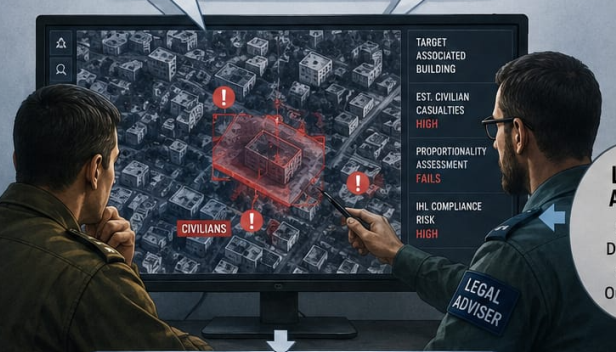
The paper examines how legal advice shapes the application of international humanitarian law (IHL) in domestic military decision-making, with particular attention to its dual role as both a limiting and a legitimizing force. Focusing on targeting decisions in high-intensity urban armed conflicts, the paper draws on experimental evidence from active military personnel and veterans to explore how legal norms are interpreted and operationalized in real time.
IHL is often understood primarily as a regime designed to constrain the use of force and mitigate harm to civilians. At the same time, a longstanding body of scholarship has emphasized its potential to legitimize violence by authorizing lawful uses of force. The paper contributes to this debate by examining how legal advice operates in practice, not as an abstract body of rules, but as an institutional mechanism through which legal standards are translated into concrete operational decisions.
The empirical analysis is based on survey experiments in which participants evaluated targeting scenarios derived from contemporary conflicts and were exposed to permissive legal advice, restrictive legal advice, or no legal advice. The design allows for a direct comparison of how different forms of legal guidance influence strike approval decisions under conditions that approximate real-world operational settings.
The findings reveal a clear asymmetry in the effect of legal advice. Permissive legal advice significantly increases the likelihood that participants will approve a strike, whereas restrictive legal advice does not meaningfully reduce approval rates relative to a no-advice baseline. In other words, while legal advice can facilitate the use of force by providing a legal justification, it is less effective in constraining it when it recommends restraint.
These results have important implications for understanding the role of IHL in practice. They suggest that, at least in the context studied, the legitimizing function of legal advice may be more robust than its limiting function.
Yahli Shereshevsky is a senior lecturer (associate professor) at the University of Haifa Law School. He was previously a post-doctoral fellow at the Federmann Cyber Security Reserach Center, the Minerva Center for the Rule of Law under Extreme Conditions, and a Grotius Research Scholar at the University of Michigan Law School. Yahli specializes in international law, focusing on international humanitarian law, international lawmaking, international legal theory, war and technology, and international criminal law.
Yahli received his PhD from the Hebrew University of Jerusalem, where he was a Hans-Guth Dreyfus Fellow for Conflict Resolution and the Law and was enrolled in the Hoffman Leadership and Responsibility Fellowship Program. Yahli holds an LLB in Law and the “Amirim” Interdisciplinary Honors Program for Outstanding Students (summa cum laude) from the Hebrew University. He clerked for the Honorable Deputy Chief Justice Eliezer Rivlin of the Supreme Court of Israel. Yahli’s work has been published in leading journals including the European Journal of International Law, the Virginia Journal of International Law, The Michigan Journal of International Law, and the Journal of International Criminal Justice.